AI in 2026: Smarter, More Useful, and Closer Than Ever
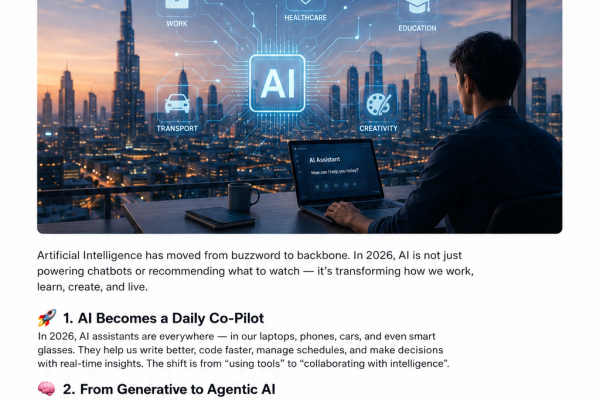
Artificial Intelligence (AI) has evolved from a futuristic concept into an essential part of everyday life. In 2026, AI is changing how we work, learn, build software, run businesses, and solve complex problems.
From AI assistants that help us complete daily tasks to intelligent systems that can plan and execute workflows, the technology is becoming more capable and accessible than ever.
But what does this mean for individuals, businesses, and the future of work?
1. AI Is Becoming Our Everyday Assistant
AI tools are no longer limited to answering questions or generating text. They can help people write emails, analyze information, create presentations, develop software, and organize their daily activities.
Instead of spending hours on repetitive tasks, professionals can use AI to work more efficiently and focus on decisions that require human judgment.
For businesses, this means faster workflows, improved productivity, and new opportunities to serve customers.
2. The Rise of AI Agents
One of the most important developments in AI is the growth of AI agents.
Traditional AI tools usually respond to individual instructions. AI agents can go further by breaking a goal into smaller tasks, using connected tools, and completing multi-step workflows with varying levels of human supervision.
For example, a business might use an AI agent to organize customer inquiries, summarize reports, or assist with software testing.
However, these systems still need appropriate permissions, monitoring, and human oversight, especially when handling sensitive information or important business decisions.
3. AI Is Transforming Software Development
Software development is one of the areas experiencing significant change.
AI coding assistants can help developers generate code, explain unfamiliar projects, identify potential bugs, write tests, and understand documentation. Experienced developers can use these capabilities to accelerate routine work and explore solutions more quickly.
However, generating code is not the same as building reliable software. Developers must still review the output, test edge cases, protect sensitive data, and maintain secure architecture.
The most valuable developers will combine strong programming fundamentals with the ability to use AI effectively.
4. AI Is Changing Education and Healthcare
AI is creating new possibilities across several important industries.
Education: AI-powered tutors can explain difficult concepts, provide practice exercises, and adapt learning materials to individual needs.
Healthcare: AI can support medical research, assist with image analysis, and help healthcare professionals process information. Clinical decisions still require appropriate professional oversight.
Business: Companies can use AI to analyze customer feedback, automate routine operations, and improve decision-making.
These applications demonstrate that AI is not simply about producing content. Its broader potential lies in helping people solve real-world problems.
5. The Challenges We Cannot Ignore
Despite its benefits, AI introduces serious challenges.
-
Accuracy: AI systems can produce convincing but incorrect information.
-
Privacy: Personal and business data must be handled responsibly.
-
Security: AI tools can introduce new risks if poorly configured or misused.
-
Employment: Some tasks and roles may change as automation expands.
-
Bias: AI systems can reproduce unfair patterns found in their training data or surrounding processes.
Organizations should establish clear policies for AI use, verify important outputs, and ensure people remain accountable for consequential decisions.
6. How to Prepare for the AI Future
You do not need to become an AI researcher to benefit from AI. Start by learning how these tools work and how to apply them to your own goals.
Here are five practical steps:
-
Learn the fundamentals: Understand what AI can and cannot do.
-
Practice regularly: Use AI to solve genuine problems rather than experimenting without a goal.
-
Develop valuable skills: Communication, critical thinking, programming, and domain knowledge remain important.
-
Build real projects: Apply AI to a useful task and evaluate the results.
-
Verify everything important: Treat AI as an assistant, not an unquestionable source of truth.
The people who benefit most will be those who combine technical skills, creativity, sound judgment, and continuous learning.
Final Thoughts
AI in 2026 represents an important shift in how people interact with technology. Intelligent assistants and increasingly capable AI agents are creating opportunities to improve productivity, expand access to knowledge, and build new products and services.
At the same time, responsible use, privacy, security, and human judgment remain essential.
The future of AI will not be determined by technology alone. It will also depend on how people choose to develop, use, and govern it.
The best way to prepare for the AI-powered future is to start learning, experimenting, and building today.